
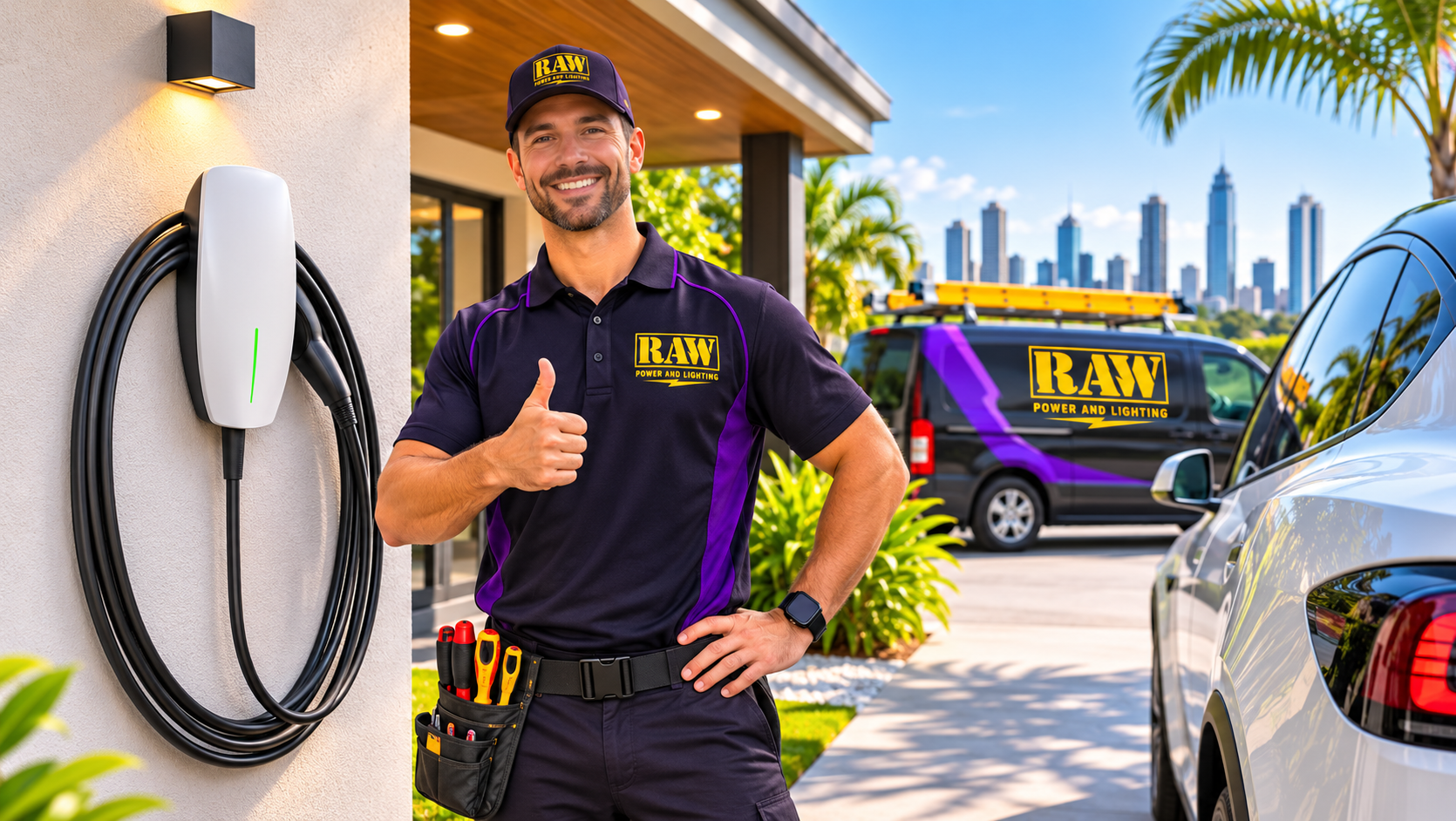
Electric vehicles are changing the way Australians think about transport, and for many Gold Coast homeowners, one of the biggest advantages of owning an EV is the convenience of charging at home.
Instead of relying entirely on public charging stations, a home EV charger can allow you to recharge your vehicle overnight or during the day, depending on your electricity plan, driving habits and available solar power.
But before installing a charger in your garage, carport or driveway, there are several important things to consider.
Home EV charger installation on the Gold Coast involves more than simply choosing a charging unit. Your home’s electrical capacity, switchboard, existing wiring, charger location and future energy needs all play a role.
Whether you live in Parkwood, Arundel, Southport or elsewhere on the Gold Coast, understanding these considerations can help you make an informed decision.
In this guide, we’ll explain how home EV charging works, what affects installation costs, how solar power fits into the picture and why professional electrical assessment matters.
1. Why Consider Installing a Home EV Charger?
One of the main attractions of electric vehicle ownership is the ability to charge where you park.
A dedicated home charger can offer several advantages:
- Convenience: Charge your vehicle at home rather than making regular trips to public charging stations.
- Faster charging: A dedicated wall-mounted charger can provide significantly faster charging than a standard household power point.
- Charging flexibility: Schedule charging around your routine, electricity tariffs or solar generation.
- Smart features: Some chargers offer mobile apps, energy monitoring and automatic charging schedules.
- Long-term planning: A professionally planned charging installation can support your household’s changing electrical needs.
For many homeowners, installing an EV charger becomes part of a wider conversation about their property’s electrical infrastructure.
That may include switchboard capacity, solar panels, battery storage and other major electrical appliances.
2. Can You Charge an Electric Vehicle From a Normal Power Point?
Some electric vehicles can be charged using a compatible portable charging cable connected to a suitable household power point.
However, charging from a standard outlet is generally slower than using a dedicated EV charger.
Not every existing power point or circuit is necessarily suitable for sustained EV charging.
The condition of the outlet, wiring, circuit protection, electrical load and manufacturer’s requirements all matter.
Never assume that an old garage power point is suitable for regular vehicle charging without an appropriate assessment.
Avoid using ordinary extension leads, power boards or unsuitable adapters for EV charging.
If you’re planning to charge an EV regularly at home, speak with a licensed electrician about the most appropriate charging arrangement for your property.
3. What Is the Difference Between a 7kW and 22kW Home EV Charger?
Home EV chargers are available in different configurations and charging capacities.
Two commonly discussed options are single-phase and three-phase chargers.
Single-Phase EV Chargers
Many Australian homes have single-phase electricity.
A dedicated single-phase EV charger commonly provides around 7kW of charging power, depending on the installation and operating conditions.
This can be a practical option for households wanting to recharge their vehicle overnight.
Three-Phase EV Chargers
Some properties have three-phase electricity.
Where the electrical installation and vehicle support it, a three-phase charger may offer charging capacity up to approximately 22kW.
However, a 22kW charger won’t necessarily charge every EV at 22kW.
The actual charging rate depends on several factors, including:
- The vehicle’s onboard AC charging capability
- The charger and electrical supply
- Available electrical capacity
- Charger settings and load management
- Battery conditions and vehicle charging controls
The biggest charger isn’t automatically the best choice.
A suitable charger should match your vehicle, driving habits, electrical installation and budget.
4. Does Your Home Need a Switchboard Upgrade for EV Charging?
This is one of the most important questions to ask before installing a dedicated home charger.
An EV charger can represent a substantial additional electrical load.
Depending on your existing installation, an electrician may need to assess:
- Switchboard condition and available space
- Existing circuit protection
- Maximum electrical demand
- Main supply capacity
- Cable sizes and cable routes
- Safety switch and other protection requirements
- Existing loads such as air conditioning, ovens, pool equipment and hot water systems
Some homes can accommodate an EV charger without major changes.
Others may require additional electrical work, load management or upgrades.
An older switchboard doesn’t automatically need replacing simply because you’re buying an EV.
The decision should be based on a professional assessment of the electrical installation.
For homeowners searching for an Electrician Gold Coast, understanding your property’s electrical capacity is an important first step in planning EV charging.
5. Important Queensland EV Charger Rule Changes in October 2026
Queensland’s electricity connection requirements have recently changed.
From 1 October 2026, Energex withdrew a previous requirement involving active management of certain single-phase EV charging installations.
This means qualifying single-phase EV chargers, including 32-amp chargers, no longer automatically require the previously specified network-controlled switching arrangements.
However, the change does not remove the need for a compliant electrical installation.
Electrical contractors must still consider:
- The property’s maximum electrical demand
- Existing supply and service capacity
- Appropriate circuit and electrical protection
- Relevant wiring and connection requirements
- Whether network or supply upgrades are necessary
Additional costs or network arrangements may still apply where the property’s electrical demand exceeds its available supply capacity.
The correct requirements depend on the installation and current network rules.
For Gold Coast homeowners, this is another reason to obtain up-to-date professional advice rather than relying on older online information about EV charger installation.
6. Where Should You Install Your Home EV Charger?
Choosing the right position can make daily charging much more convenient.
Common locations include:
Garage
A garage is often a practical location because the vehicle is usually parked in a predictable position and the charging equipment is protected from direct weather exposure.
Carport
A carport can also be suitable, provided the charger and installation are appropriate for the environmental conditions.
Driveway or External Wall
For homes without enclosed parking, an outdoor-rated charger may be an option.
The installation needs to consider exposure to rain, sunlight, possible flooding and physical damage.
When planning the location, consider:
- Where the vehicle’s charging port is positioned
- Charging cable length
- Ease of parking
- Pedestrian access and trip hazards
- Distance from the switchboard
- Weather exposure
- Whether you may purchase a different EV in the future
The shortest cable route isn’t always the most convenient location.
A properly planned installation should balance practicality, safety and cost.
7. Can You Charge Your EV Using Solar Panels?
Yes. One of the most attractive possibilities for homeowners with rooftop solar is using some of their solar generation to charge an electric vehicle.
If your solar system is generating electricity while your vehicle is charging, that energy may help reduce the amount of electricity you need to purchase from the grid.
Some smart EV chargers can monitor available solar generation and adjust charging to make better use of surplus solar energy.
However, several factors affect how much solar energy can be used:
- Solar system size
- Time of day
- Weather conditions
- Household electricity consumption
- EV charging demand
- Charger compatibility and settings
- Whether the vehicle is parked at home during daylight hours
For example, a household where the EV is parked at work during the day may have different charging opportunities from a household where the vehicle is regularly at home.
A solar battery may offer additional flexibility, but the financial benefits depend on the system, battery capacity, charging arrangements and electricity tariffs.
If you’re considering Solar Installation Gold Coast, Solar Battery Installation Gold Coast or a future EV charger, it can be worthwhile planning these systems together.
That way, your electrical infrastructure can be assessed with both current and future energy requirements in mind.
8. How Much Does Home EV Charger Installation Cost on the Gold Coast?
The total cost of installing a home EV charger depends on more than the price of the charging unit itself.
Installation costs can vary based on:
Charger selection: Different models offer different charging capacities, features and compatibility.
Distance from the switchboard: Longer cable routes can require more materials and labour.
Switchboard requirements: Some properties need additional circuit protection, modifications or upgrades.
Electrical supply: The existing single-phase or three-phase supply can influence the options available.
Installation location: Garage installations, external walls and detached structures can involve different requirements.
Cable access: Difficult cable routes, underground cabling or building access may increase the work involved.
Smart charging features: Solar integration, energy monitoring and load management can affect equipment selection and setup.
Network requirements: In some circumstances, additional supply or connection work may be required.
Rather than relying on a generic online installation price, arrange an assessment and obtain a quote based on your property and intended charger.
A clear quote should explain the proposed equipment, installation scope and any additional electrical work identified.
9. Can You Install an EV Charger Yourself?
No. A fixed home EV charger must be installed by an appropriately licensed electrical professional.
In Queensland, electrical installation work is regulated, and businesses carrying out electrical work for customers must hold the appropriate electrical contractor licence.
Installing an EV charger can involve new wiring, circuit protection, switchboard work and electrical testing.
Incorrect installation can create serious electrical and fire hazards.
Even if you’ve already purchased a charger online, it still needs to be assessed for compatibility and professionally installed.
Never attempt DIY fixed EV charger installation or modifications to your home’s electrical wiring.
10. What About EV Charging in Apartments and Rental Properties?
Home EV charging isn’t limited to detached houses, but apartments, townhouses and rental properties can involve additional considerations.
For apartment buildings and other strata-managed properties, installing a charger may require body corporate approval and consideration of shared electrical infrastructure.
In rental properties, tenants generally need the property owner’s approval before installing a fixed charging station.
Questions may also arise around electricity metering, access to parking spaces, installation costs and responsibility for maintenance.
If you live in a shared building, it’s best to clarify the approval process before purchasing charging equipment.
11. How Long Does It Take to Charge an EV at Home?
Charging time varies depending on the vehicle and charging arrangement.
The main factors include:
- Vehicle battery capacity
- Current battery charge level
- Desired charging level
- Available charging power
- Vehicle onboard charging limits
- Charging losses and operating conditions
As a simple example, adding 35kWh of energy to a vehicle battery using a charger delivering approximately 7kW would take roughly five hours in ideal conditions, and longer once real-world charging losses and other limitations are considered.
A larger battery doesn’t always mean you need the fastest possible charger.
If you drive relatively short distances each day and regularly park at home overnight, a suitable single-phase charger may meet your needs.
The right charging solution depends on how you actually use your vehicle.
12. Questions to Ask Before Installing a Home EV Charger
Before committing to an installation, ask your electrician:
- Is my existing switchboard suitable for the proposed charger?
- Does my electrical supply have enough available capacity?
- Would single-phase or three-phase charging be more appropriate?
- What charging speed can my vehicle actually support?
- Where should the charger be positioned?
- Are additional circuit protection or electrical upgrades required?
- Can the charger work with my existing or future solar system?
- Would load management or smart charging be useful?
- Are there any applicable Energex connection requirements?
- What is included in the installation quote?
These questions can help you compare options and avoid purchasing equipment that isn’t suitable for your home.
Home EV Charger Installation in Parkwood, Arundel, Southport and Across the Gold Coast
Gold Coast properties have different electrical requirements.
An established home in Parkwood may have a different switchboard and supply arrangement from a newer property in Arundel or a townhouse in Southport.
The right EV charging solution depends on the individual property, not simply the suburb.
At Raw Power & Lighting, we understand the importance of properly planned residential electrical installations.
As a family-owned Gold Coast electrical business, our approach focuses on:
- On-time guarantee
- No call-out fees
- Plain-English advice
- Respect for your home and property
Whether you’re preparing your home for an electric vehicle, considering a switchboard upgrade or planning improvements to your solar and electrical systems, professional advice is an important starting point.
Preparing Your Gold Coast Home for Electric Vehicle Charging
Installing a home EV charger can make electric vehicle ownership more convenient and give you greater control over when you charge.
But the best results come from planning ahead.
Before choosing a charger, consider your vehicle, daily driving needs, available electrical capacity, charging location and potential solar integration.
Queensland’s recent EV charging connection changes also make it important to seek current advice rather than relying on outdated installation guidance.
Thinking about installing a home EV charger on the Gold Coast?
Contact Raw Power & Lighting to discuss your property’s electrical requirements and confirm the availability of EV charging installation services.
From Parkwood and Arundel to Southport and surrounding Gold Coast suburbs, Raw Power & Lighting provides local electrical expertise for homeowners and businesses.
Raw Power & Lighting — Your Local Gold Coast Electrical, Solar and Air Conditioning Specialists.